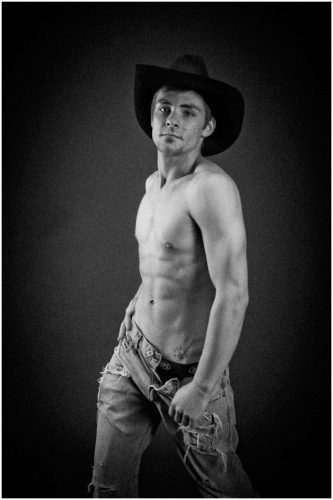
 Last night I watched an old western called Red River directed by Howard Hawk originally released in 1948. It was a John Wayne classic featuring one of the most beautiful men to ever be photographed, Montgomery Cliff. This was his first major feature film and made him an overnight sensation. He was 26 years old at the time of shooting and is just stunning to watch in this old black and white epic. Part of what makes the film so brilliant is the lighting is fantastic though out the film and though I have seen this film a dozen times it still mesmerizes me. After watching it last night I began to see how much of an influence it has had on my style of photography and the development of my approach to lighting. Of course growing up in the west, I identify with the sexual allure of the cowboy, particularly Montgomery Cliff. In this film he embodies it all, handsome, strong yet sensitive, compassionate, and secure in his masculinity. He was my role model and became the one icon I could always look up to because he stirred such strong feelings of desire within me for this sort of male figure and I began to recognize my sexual attraction was definably toward men. There is a very wonderful scene in the film in which he and another wrangler named Cherry admire each other’s guns in a very homoerotic flirtatious manner that is quite suggestive of something other than shooting. He was one of the first movie stars that I found out was gay which deepened my desire. Though he often play emotionally tortured men, his characters seemed to become a mirror of his personal life and struggles which seem to somehow personify everything I felt. Every time I saw him on the screen I become absorbed by the depth and pain he brought to each character. He was a man who was able to tap into this own pain and reveal his very soul for others to see. Few movie stars have brought this much honesty to the screen, except maybe James Dean. This is a quality I strive for in my own imagery, a moment of bearing the humanity of ourselves and exposing who we are in our existence. Cliff is one of the few actors to consistently maintain this intensity making almost every film an instant classic: A Place in the Sun, From Here to Eternity, The Heiress, Raintree Country, Suddenly Last Summer and even the Alfred Hitchcock classic I Confess.
I have often pondered how a young ranch kid like myself was so drawn to work in arts and entertainment. Last night that connection became clear watching Red River, the magic, the beauty, the sexual allure of the American west, my west, stirred my emotions , presented in the flicker of a film and watching Montgomery Cliff enter my universe. I identified with a feeling where anything was possible and knew it was a place I could coexist and where I would be understood and accepted for my difference. Where the tormented soul can reveal itself and become the basis of artistic expression. Monty though you died when I was just a kid, you still live in my heart decades later and stir a desire and passion within me that will never dissipate. You only seem to grow stronger with time as the truth of your worlds real and make believe still haunt me.
 I opened my laptop this morning and linked to my friend Elizabeth’s blog and saw that her post today was about the recent great news she received from a doctor visit. Her MS is beginning to dissipate as the lesions on her brain are shrinking and beginning to disappear. My heart leapt for joy to hear such news as she describes it as getting an early wonderful Christmas gift. Elizabeth is one of the most extraordinary people I have never actually met, because despite having been diagnosed with MS several years back and it completely disrupting her life, she has somehow managed to reclaim her life. She is the mother of two children yet still manages to become a writer. She takes us into the steamy heart of male on male romance, maintain a blog and non-stop helping me with the editing of The Naked Man Project. This is a woman of extreme vision and fortitude to overcome all odds and defy what probably should disable her.
 For some reason I have been thinking lately about the lonely death of the American writer Tennessee Williams. Here is a brilliant man who has crafted some to the greatest plays of all time for the American Theater. Things like A Streetcar Named Desire, The Glass Menagerie, and Cat On A Hot Tin Roof. He choked to death on the cap of some eye drops he was trying to open with his mouth on February 25, 1983. How is it that a man with such a great mind for creating some of the most fascinating and complex character studies can pass away from something so insignificant as a bottle cap? Tennessee Williams is probably one of the most influential people on my life and work. As a young theater student in my twenties, when I had finally entered his remarkable world, I felt like I had finally found a home. He wrote about all the things we as culture in Montana like to keep hidden and considered taboo: alcoholism, homosexuality, addiction, beauty, the loss of beauty, fear, doubt, and self-loathing. A world where people were trapped by their often-brutal existence. Nothing seemed sacred to Tennessee. He himself grew up in a shattered world, feeling closest to his sister Rose. She was schizophrenic, in and out of hospitals, eventually becoming lobotomized; she became the wellspring for much of his characterizations. He used the dysfunction of his life to add life to those remarkable characters of Blanche, Brick, Laura, or Alma. Everything he wrote seemed to plummet into the heart of darkness whether it was a play, novel, or even a short story. His writing was filled with passion, honesty, and above all humility. When I entered this world I somehow knew most of these characters and could see so much of his despair and depression within myself. I became addicted and spent a year reading everything consumable about the man. Eventually I directed a production of The Glass Menagerie for my senior project at the University. I still get a giddy feeling when I read anything written by this master and am still captivated by the ground away versions of the Hollywood classics. That scene with Elizabeth Taylor blurting out the truths of Sebastian using her for procurement of young boys leading to his cannibalistic death before she is about to be lobotomized by his mother, Katherine Hepburn, who will do anything to keep the truth hidden in
 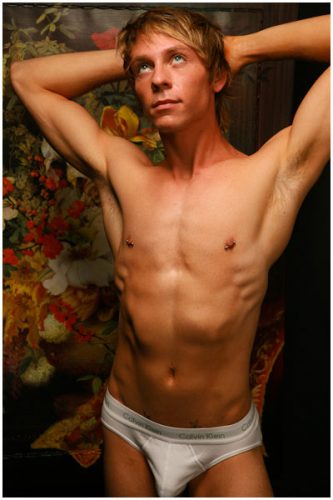 I am strongly becoming empowered by other artists’ images. I have been working with several other artists from around the world who have submitted images and writings that I have been creating galleries of for this project. It means spending a great deal of time with each image to build page by page and the more I study others work and talk to them the more I somehow become connected to their worlds. There is such strength in the impression they impart on their works no matter the style of medium they work. Each piece needs to be studied individually to really understand its power. In many ways it’s unfortunate to show such a large body of work because it forces us to skim through it as a collection without really paying attention to the detail. Where as each piece is a single moment suspended in time, which has often taken hours, days, some times even months to create. I am beginning to realize the images should be looked at individually. Unfortunately, we live in a world where we are inundated with so much imagery that we often just spend a few moments working our way through the vastness of it all. In olden days, images were hung on a wall of a gallery, museum, or salon and you were forced to interact and respond to the pieces that hung before you and when something really caught your eye you could linger and try to unravel it’s mysterious influence. I don’t think this happens so much anymore. We may bookmark or download an image and it becomes part of a vast collection, we may never even get back to again, because there is something new to see. And often times when we do go back and look at an image it will not have the same impact it had in the first place because we have changed and now see it from another perspective. But if we linger long enough, the power of the artists’ vision begins to take hold and influences the way we see ourselves and our own sense of our own creation and we see the artist as a mirror to ourselves. In the 1972 version of the film “Cabaret” the director Bob Fosse borrowed an idea from the original script in which the play ends by dropping a large mirror down so the audience can literally see the reflection of themselves revealing and asking us to examine the judgmental racism of Nazi Germany within ourselves. It is a powerful moment of the show. Though it doesn’t quite work on film the mirror is still there and becomes a reflection turning our focus inward. Art dealing with the still taboo subject of male nudity still has that impact and I am delighted to be and adoringly enamored to the be the in company of such amazing talents.
 I have a young extremely talented filmmaker friend who has developed a brilliant script that he is trying to raise funding to produce. It’s going to be an extremely low budget film with a wallop. I have read the script and it very good and having seen this kid’s work from the past I totally can see his vision and know he can pull it off to create something extraordinary. The story centers around a guilt-ridden custodian of a decaying hotel that is dragged back from despair by a mercurial young woman with her own bleak past.